Entangled
Duo-Solo Exhibition: Latifa Medjdoub & Henri Kalama
OpenArtExchange is proud to present Entangled, a duo-solo exhibition featuring works by contemporary artists: Latifa Medjdoub aka Laftmonk & Henri Kalama. We warmly invite you to the opening on Saturday, November 7th at 15h00 at OpenArtExchange, Hoogstraat 85, Schiedam. For the opening, we are pleased to welcome Latifa Medjdoub, who following her residency, will be present to share insights into her work and artistic practice.
The exhibition will be on view until Saturday, December 19th 2026.
Entangled
Entangled explores the invisible links that bind beings, emotions, materials, and worlds. To be entangled is to be closely interwoven with something else, in a state where one element inevitably affects another. The exhibition considers these systems of connection as living structures: complex, unstable, and constantly shifting, like ecosystems in which every action can generate both positive and negative consequences, order and disruption, growth and tension.
Through distinct yet resonant abstract languages, Latifa Medjdoub and Henri Kalama create dense networks of colour, fibre, texture, and form. Their works evoke systems in which individual elements overlap, cross, separate, and reconnect, forming complex structures whose relationships cannot always be immediately untangled. Seen together, their works enter into a physical dialogue. Medjdoub’s threads form intricate, architectural structures, while Kalama’s layered colours and textures give his compositions a fibrous or threadlike quality. Fibre and thread thus emerge not only as materials or visual forms, but as structures of connection: individual lines and elements becoming part of something larger than themselves.
For Henri Kalama, abstraction is not born in opposition to figuration, but as an action. Working with palette knives, Kalama gives form to his inner turmoil, sensations, and thoughts. For him, abstraction does not mean the absence of reality, nor does it constitute a rejection of figuration. Rather, it seeks to reveal what is essential within reality—to distil it, condense it, and bring it to its most concentrated form. In this sense, abstraction can be understood in relation to the word “abstract” as it is used at the beginning of a scientific paper: not as something detached from reality, but as a concise synthesis that retains what is essential while leaving aside what is secondary. As representative elements recede, colour, light, and texture remain. For Kalama, colours are the most profound expressions of emotional states and inner experiences that cannot easily be translated into words. They carry sensations, memories, places, and states of being that lie beyond rational language. Layers of paint accumulate, conceal, and reveal one another, creating passages in which colour seems to emerge and disappear. Kalama conceives abstraction as a shared emotional language, one capable of reaching beyond cultural and geographical boundaries. His work suggests that no emotion is entirely solitary: whether positive or negative, what we feel can find echoes in the experiences of others. Through this recognition, abstraction becomes a space in which individual experience enters a larger emotional field.
These invisible connections, made up of individual paths entangling with one another, are at the centre of Latifa Medjdoub’s sculptural practice. Threads and fibres intertwine into structures that exist somewhere between organism and architecture. In her ongoing series Entrelacs (Interlaces), Medjdoub draws upon traditions of interwoven and symmetrical motifs to explore interconnectedness as both form and principle. As lines meet and diverge, overlap and separate, they form multidirectional systems in which each element evolves in relation to another. No single thread exists independently from the structure around it: tension in one part alters the balance of the whole. These complex forms resonate across different scales, from bodies, to natural ecosystems or social networks.
Bringing Kalama and Medjdoub into dialogue, Entangled considers what lies beneath the appearance of separate things. Across painting and textile sculpture, both artists construct intricate systems of relation, suggesting one vast ecosystem of interconnected forms, emotions, materials, and lives. Within it, nothing exists entirely alone: crossings, tensions, dependencies, and exchanges continuously reshape the whole, whether visibly or invisibly.
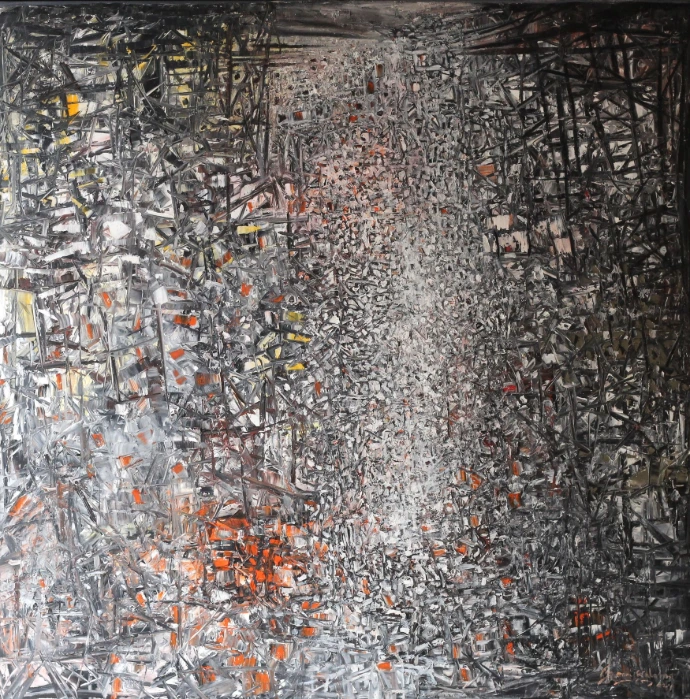
Henri Kalama
DRC, 1973
Henri Kalama is an established Congolese visual artist, scholar and professor. Through Abstraction, Kalama explores how colour can convey emotion, spirituality and human connection beyond the boundaries of language and culture. His layered compositions invite viewers to engage with the work intuitively, reflecting on interconnectedness and the shared human experience. Director of Kinshasa's Academy of Fine Arts, Kalama recognition as both an artist and educator has made him a key figure in the ongoing conversation about African art in the global contemporary art scene.
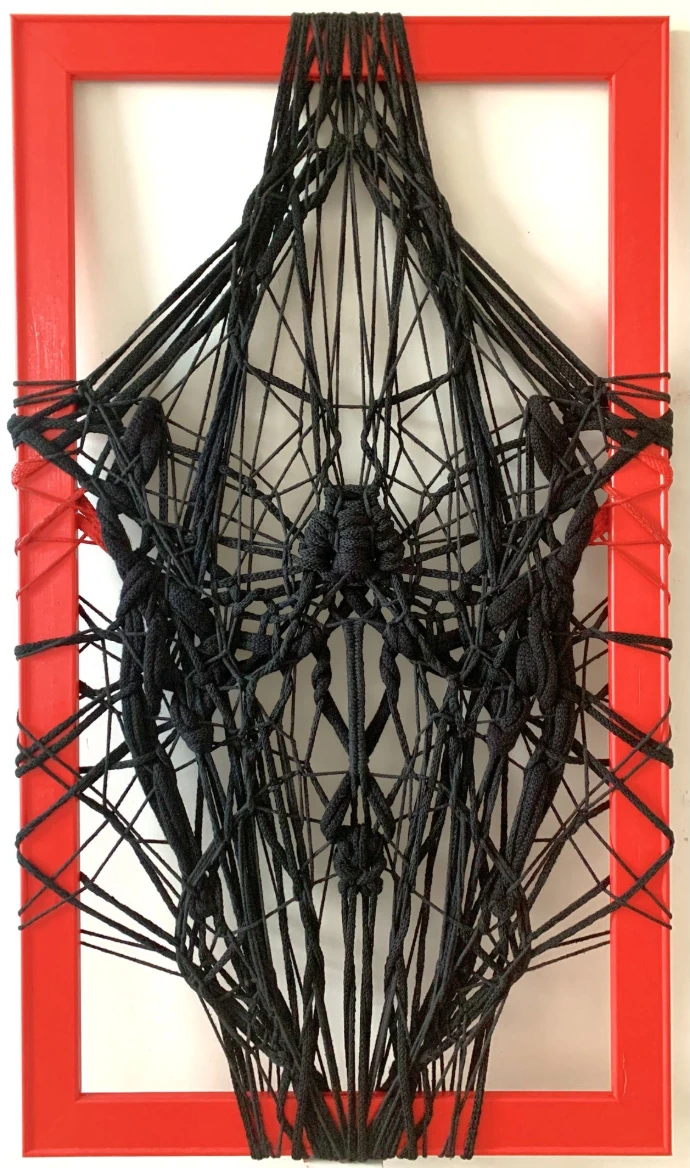
Latifa Medjdoub aka Laftmonk
France/USA, 1973
Latifa Medjdoub, aka Laftmonk, is a French-Algerian multidisciplinary artist working across textile, painting, installation and participatory practice. Her textile works form intricate networks of thread, fibre and rope, exploring connection, interdependence and transformation. These complex structures illustrate how separate elements, identities and histories can meet, influence one another and become part of larger relational structures. Medjdoub's works has been presented internationally across a wide range of museums, art centres and cultural institutions.