Another World of Blue
geinspireerd door Yves Klein in Stedelijk Museum Schiedam
On March 21st 2026, the Stedelijk Museum Schiedam unveiled its landmark exhibition, Yves Klein en zijn Kunstenaarsfamilie. To mark this significant opening, and at the occasion of Schiedam's IDDF Around Town Festival, OpenArtExchange presents its dedicated Another world of blue corner in connection with the citywide celebration of the Yves Klein heritage. A vibrant blue wall will host a curated selection from two of our African contemporary artists, inviting visitors to explore the expressive and immersive power of the colour blue today.
Yves Klein, Blue and the Infinite
Yves Klein (1928-1962) was a major figure of the twentieth-century avant-garde movement. Through his series of monochromes, he pursued a radical vision of abstraction. Klein sought to free painting from form, line, and personal style, creating pure colours, making the absolute visible. His International Klein Blue evokes the sky and sea, boundless spaces where viewers are invited to experience the infinite. Beyond his iconic blue, pink and gold also play an important role in Klein's oeuvre. Gold symbolises light and eternity, while pink refers to human sensitivity. Each colour becomes, for the artist, a vessel to dialogue with the universe and to attempt to experience the absolute in their depth.
The exhibition Yves Klein en zijn Kunstenaarsfamilie, at the Stedelijk Museum Schiedam, expands this vision, presenting works by Klein's relatives, each displaying their own sensitivity to colour. Together, they highlight the unique quality of colour as a vessel for emotion and dialogue. Before form or any figurative aspect, it is colour that first moves the viewer, that can translate into an emotional experience.
Another World of Blue - Tchif Tchiakpe
Our selection features works by Tchif Tchiakpe (1973), a master colourist whose richly layered paintings explore humanity's relationship with the universe. Seeking to free himself from imposed figures, he embraces a form of abstract expressionism. His compositions, full of depth and movements, create a unique immersive space for contemplation. Tchif Tchiakpe's works include cryptic forms, crosses, circles and lines, each with a deep symbolic character, evoking the imperceptible laws that govern the universe.
In Le Partage, Tchif Tchiakpe experiments with tones of blue, caught in movement, bleeding into one another to create a unique sense of depth. The viewer is plunged into an oneiric universe of colour, momentarily detached from the surrounding world. Cutting across the composition, vivid lines represent traces left by humanity on earth, while circles, crosses, arrows, symbolise suffering, continuity, and the ryhtms of life, aiming to speak to universal experiences. Beyond blue, like Yves Klein, Tchif Tchiakpe experiments with other colours, yellows, ochres, or reds. For him, colour is both complex and essential, carefully selected palettes express his vision with intensity, reaching toward shared human emotion.

Iconic Blues
Extending this exploration of colour, our selection also features ceramic work by Benjamin Deguenon (1982). While Yves Klein developed his own iconic blue, carrying historical significance in its use of colour as a space in itself and as a form of research into the perfect shade, Deguenon engages here with another historically significant blue: Delft Blue. Developed during his residency in the Netherlands, his Egungun series draws on this tradition, transforming it through a contemporary and cross-cultural lens. Here, blue moves into three dimensions and into figuration. No longer a boundless void, it becomes ornamental, symbolic, and narrative. Through these hybrid works, Deguenon connects artistic legacies across cultures, tapping into a shared visual memory.
In this piece, Egungun series 8, the ceramic form evokes a ceremonial mask, inspired by ancestral Egungun traditions from Benin. Egunguns are ancestral figures represented during ceremonies through elaborate masked costumes that embody and honour the spirits of ancestors. They are here recognisable through the shells represented in the front of the piece. Beyond the ornamental blue, Deguenon integrates other significant Delft ceramic elements, such as the animal forms crowning the piece, also often found atop vases and covered jars. The back of the piece reveals Deguenon's universe in full, translated through the iconic cobalt blue: hybrid characters intertwine and extend across the surface. The result is a series of works unique in character, where historical and cultural artistic heritages meet, from ancestral spiritual traditions to historical ornamental techniques, merging into a continuous dialogue across surfaces and forms. Through this layered use of cobalt blue, the work shows how a single colour can carry, translate, and connect different cultural imaginaries across time and geography.

Brandersfeesten Selection Sneakpeak
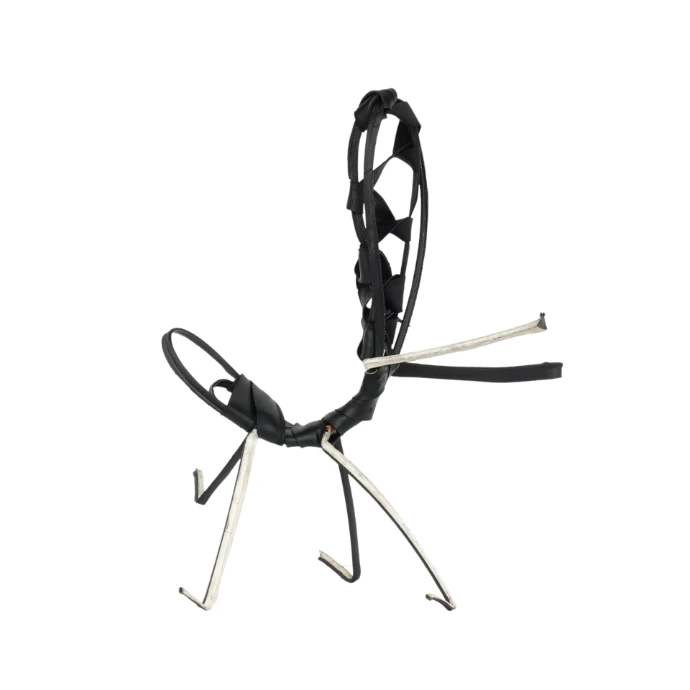
Fragility Series - 16, 2026
Marcel Kpoho | Assembly of tire stripes and mixed media | 43x30x40 cm
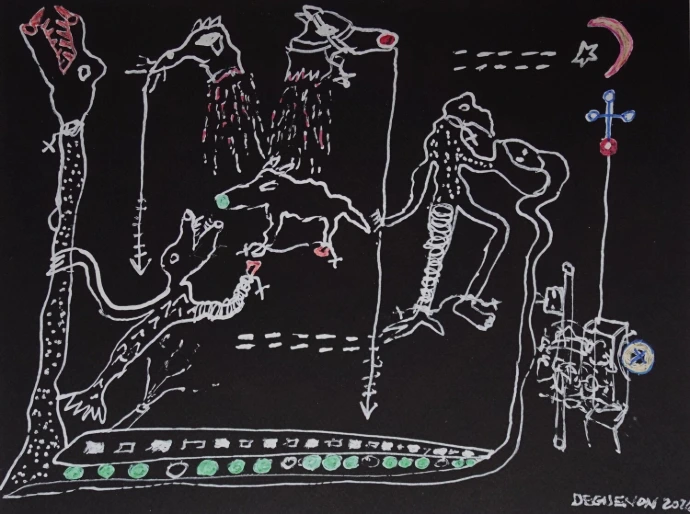
Dialogue Series - 33, 2020
Benjamin Deguenon | Acrylic and concealer on paper | 25 x 32 cm
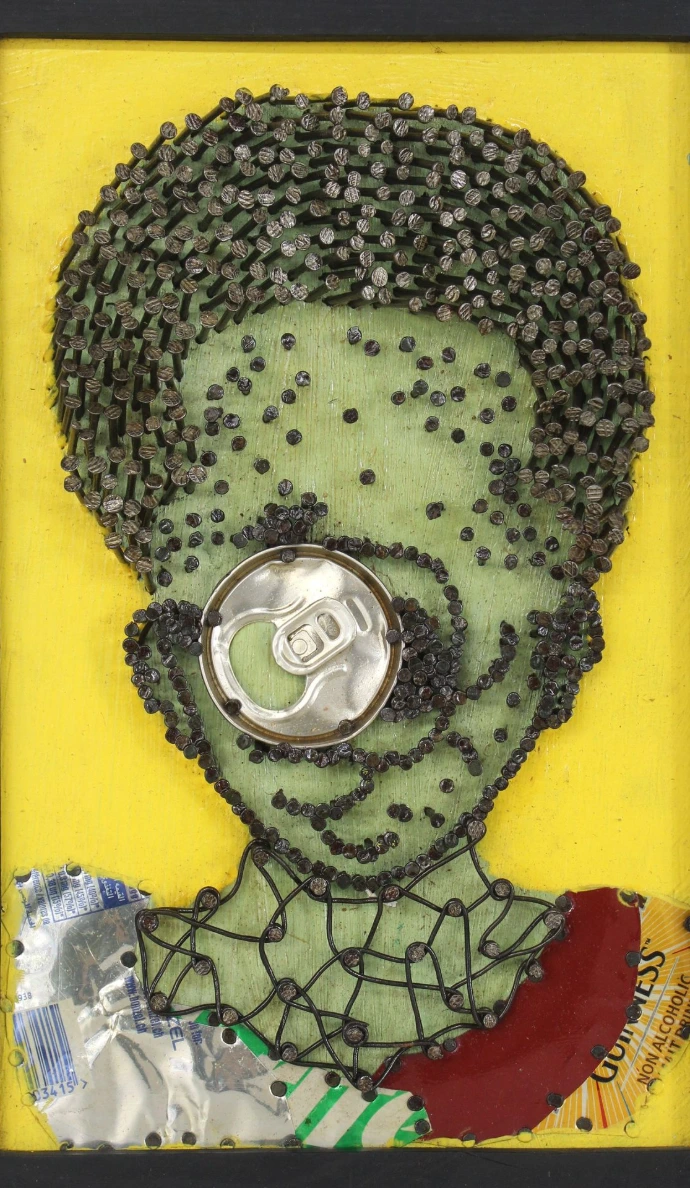
Inconnus connue inconnus II, 2023
Syl Loko | Nails, acrylic on plywood | 30x19cm
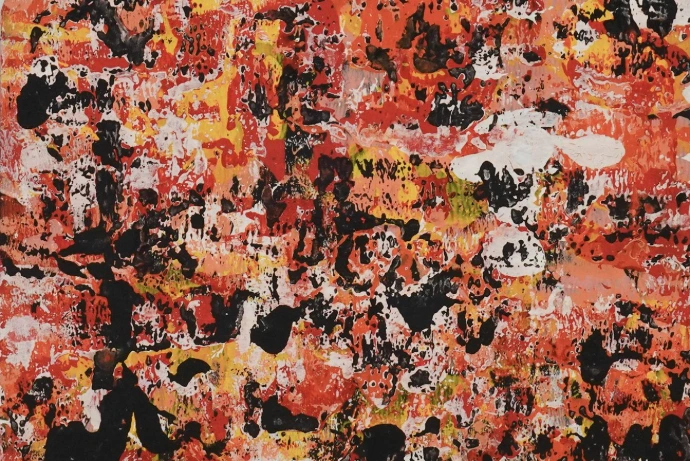
Nature rechauffée 6, 2025
Richard Laté Lawson-Body Acrylic on board | 29,6 x 21 cm